


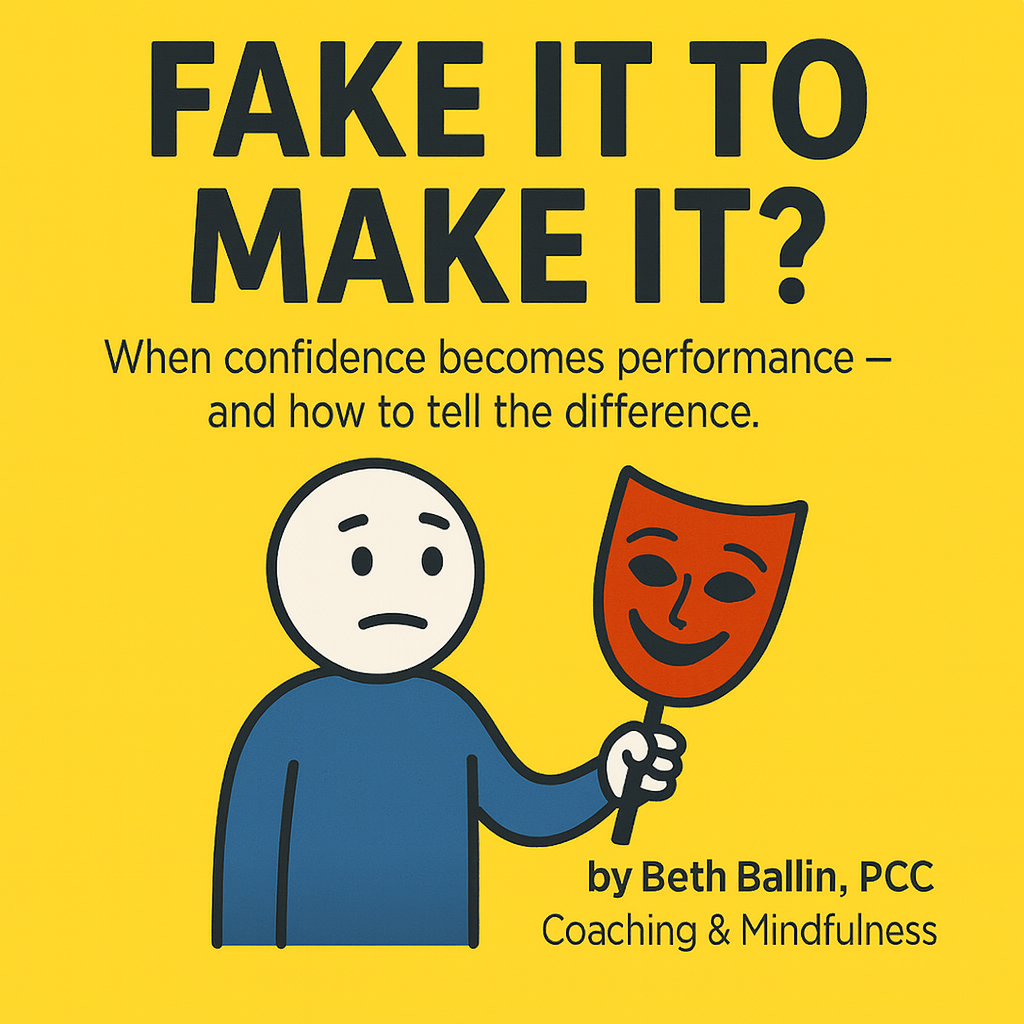
Living abroad often means adapting, learning the language, understanding the customs, and finding your place. Yet there is a fine line between growing into confidence and performing for acceptance. In this piece, as a coach and mindfulness practitioner, I explore how “faking it till you make it” helps us grow, when it limits us, and how authenticity helps us truly belong.
Where It Began
I first heard the phrase “fake it till you make it” during my Mindfulness-Based Stress Reduction training at UMass. It was offered as a thoughtful tool. It struck me as both amusing and familiar, and it reminded me of advice I once gave my daughter when she was starting school. She was painfully shy and afraid of rejection. I encouraged her to imagine someone friendly and popular and asked, “What do you think makes her so popular?” Based on her answers, I offered a few simple scripts, not to turn her into someone else, but to help her feel safe enough to show up as herself. It worked. She did not suddenly become outgoing, but she found her own way to belong, and that was enough.
From Growth Tool to Performance Trap
Years later, as a coach, I began noticing how the phrase had changed. What once served as a starting point for growth had become a strategy for constant performance and self-promotion.
The Expat Dimension
For many expats, “faking it” is part of everyday adaptation: learning customs, adjusting tone, and searching for belonging in a new culture. The process can be both exciting and exhausting. In the early stages, it helps us find connection and stability. But when adaptation hardens into performance, we can start to feel invisible or unsure who we really are.
The Coaching Perspective
In coaching, these moments become
invitations to pause and notice what is real. Coaching helps lighten the weight
of the roles we play and clarifies when we are stretching for growth versus
performing for approval. Even brief pauses, before or after a meeting, can
reveal whether we are acting from courage or from habit.
One client told me that after months of practicing her “local voice,” she
realized it was no longer an act; it had become a natural part of who she was.
For expats, this reflection is especially valuable. The “local voice” you adopt
is not false; it is part of belonging. Over time, these adaptations blend with
your authentic self, creating a more flexible and grounded identity.
The Social Media Effect
Shaping our image is not new. We have always adjusted tone to fit in and presented curated versions of ourselves in social settings, job interviews, and rituals. What has changed is the pace and pressure. “Fake it” has shifted from simple encouragement to a performance for algorithms. Behind every post lies the same ancient impulse that once helped us survive: to be seen, accepted, and valued. The difference is that we now perform for strangers. When connection turns into constant performance, we start chasing validation instead of reflection. Worn too long, the mask hardens into a persona we dare not take off. Success built on that image can become a trap, especially when we neglect the person behind it.
When the Curtain Falls
When performance no longer brings validation, the silence can feel unsettling. What began as a stretch or coping strategy starts to take over. The role we created to connect begins to weigh us down. When we lose touch with why we are doing this, anxiety and disconnection creep in. We may get good at playing the part but lose touch with the person underneath. The performance gets noticed, but the person, not so much. Eventually, the question comes: Who am I, really, if I stop pretending?
The Man Behind the Curtain
I often think of that moment in The Wizard of Oz when Toto pulls back the curtain, revealing that the great and powerful Wizard is just an ordinary man pulling levers, hiding behind smoke and sound effects. Flustered, he tries to salvage the illusion: “Pay no attention to that man behind the curtain!” But the truth is out, and eventually he admits: “I’m a very good man, but a very bad wizard.”
The moment is revealing not only because his image slips, but because it shows how someone can become so invested in the act that they lose sight of who they are. The Wizard wanted to be admired and respected by the people of Oz, but he ended up isolated and afraid, hidden behind a screen of his own making. At the end of the film, he is grateful to be found out, to let go of the illusion, and return to Kansas, his real home. It is a metaphor, perhaps, for coming back to his true self.
Coming Home to Ourselves
We all wear masks to learn, cope, survive, connect, and create. But when the mask becomes embedded in how we present ourselves, we risk forgetting who we truly are. Like the Wizard, we may have good intentions, but if we lose touch with the person behind the curtain, we risk mistaking the performance for the person.
Faking it, when guided by care and intention, can be a meaningful stepping stone. Driven by fear or habit, it becomes a trap. That is why taking breaks from our made-up selves matters. Connection without performance helps us reset. We find it in presence, conversation, play, music, or time in nature. For many expats, and really for anyone navigating change, it can mean finding spaces, people, or places where we can simply be ourselves. Those moments bring us home and remind us who we are.
Elizabeth (Beth) Ballin is a Professional Certified Coach (ICF) and mindfulness practitioner based in Switzerland. Through Modern Health and her private practice, she helps professionals and expats reduce stress, clarify goals, and build strengths, confidence, and creativity – in work and life. Connect with Beth Ballin on LinkedIn or email elizabeth@ballincoaching.ch.